
- Go to the basement or take shelter in a small interior ground floor room such as a bathroom, closet or hallway.
- If you have no basement, protect yourself by taking shelter under a heavy table or desk.
- In all cases, stay away from windows, outside walls and doors.
Tornado Facts
-
Canada gets more tornadoes than any other country with the exception of the United States.
-
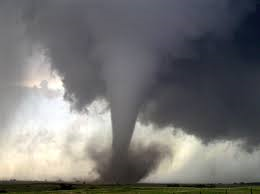
Tornadoes are rotating columns of high winds.
- Sometimes they move quickly (up to 70 km/hour) and leave a long, wide path of destruction. At other times the tornado is small, touching down here and there.
- Large or small, they can uproot trees, flip cars and demolish houses.
- Tornadoes usually hit in the afternoon and early evening, but they have been known to strike at night too.
Warning signs of a potential tornado
- Severe thunderstorms, with frequent thunder and lightning
- An extremely dark sky, sometimes highlighted by green or yellow clouds
- A rumbling sound or a whistling sound
- A funnel cloud at the rear base of a thundercloud, often behind a curtain of heavy rain or hail
Canada's tornado warning system
Environment Canada is responsible for warning the public when conditions exist that may produce tornadoes. It does this through radio, television, newspapers, its internet site, as well as through its weather phone lines.
- If you live in one of Canada's high-risk areas, you should listen to your radio during severe thunderstorms.
- If you hear that a tornado warning has been issued for your area, find shelter and follow the instructions below.
What to do during a tornado
- Get as close to the ground as possible, protect your head and watch for flying debris.
- Do not chase tornadoes - they are unpredictable and can change course abruptly.
- A tornado is deceptive. It may appear to be standing still but is, in fact, moving toward you.
- Livestock hear and sense impending tornadoes. If your family or home is at risk, the livestock will be a non-issue. If your personal safety is not at risk, you may only have time to open routes of escape for your livestock. Open the gate, if you must, and then exit the area in a tangent direction away from the expected path of the twister.
If you are in an office or apartment building
- Take shelter in an inner hallway or room, ideally in the basement or on the ground floor.
- Do not use the elevator.
- Stay away from windows.
If you are in a gymnasium, church or auditorium
- Large buildings with wide-span roofs may collapse if a tornado hits.
- If possible, find shelter in another building.
- If you are in one of these buildings and cannot leave, take cover under a sturdy structure such as a table or desk.
- More than half of all deaths from tornadoes happen in mobile homes.
- Find shelter elsewhere, preferably in a building with a strong foundation.
- If no shelter is available, lie down in a ditch away from the car or mobile home. Beware of flooding from downpours and be prepared to move.
- If you spot a tornado in the distance, go to the nearest solid shelter.
- If the tornado is close, get out of your car and take cover in a low-lying area, such as a ditch.
Contact Us
Municipal Office
217 Harper Road,
Perth, Ontario, K7H 3C6
Phone: 613-267-5353
Toll-Free: 1-800-810-0161
Email Us
Hours of Operation
Monday to Friday
8:30 a.m. to 4:00 p.m. except on Statutory Holidays.
Sign up to our newsfeed
Stay up to date on the municipality's activities, events, programs and operations by subscribing to our eNews


